
Welcome message


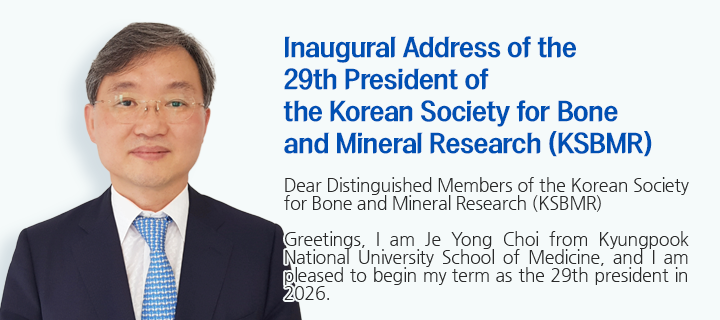
First, I would like to express my deepest gratitude to former President Chan Soo Shin, Director Ki Hyun Baek, Secretary General Hyun Sik Gong, and all executives and members who were dedicated to advancing society during the previous term.
Our community has entered an era of a super-aged society, with many people now living to 100 years and beyond. Today, musculoskeletal conditions such as osteoporosis and sarcopenia go beyond aging itself and have a profound impact on quality of life. Furthermore, rapid advances in AI technology are creating unprecedented opportunities for disease prediction, diagnosis, and treatment. In the midst of this rapidly changing world, our society seeks to pursue the following three goals to fulfill its social responsibilities and achieve academic excellence.
• Strengthening AI-Driven Precision Medicine: We will actively embrace AI technology in the clinical setting, opening new horizons for early disease detection and personalized treatment.
• Health Management Across the Life Course: By implementing a systematic model for disease prevention and management, we aim to ensure that everyone can maintain a healthy musculoskeletal system throughout their lives.
• Securing Global Leadership: We will strengthen multidisciplinary collaboration and international networks, while expanding academic exchanges and joint research efforts, to enhance our standing as a global academic organization.
In line with our slogan, ‘Healthy Bone, Strong Tomorrow,’ I will work closely with all members—especially Chairman Sang Wan Kim, Vice-President Jung-Min Koh, and Secretary General Jeonghoon Ha—to bring out everyone’s full potential and ensure that KSBMR stands strong as a pillar supporting people’s health.
I will lead the continued advancement of our society, and I wish health and happiness to all our members and their families in 2026.
Thank you.
January 2026
President of the Korean Society for Bone and Mineral Research (KSBMR)
Je-Yong Choi
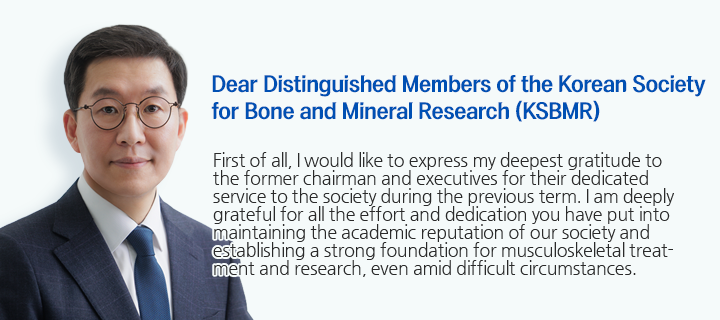
As Chairman of KSBMR, I am well aware of the responsibility that comes with serving in this important role. At the same time, I feel honored to walk the same path with all our members as we reflect on our future directions, just as we have walked together in the past.
Today, we find ourselves in challenging medical and research environments.
The recent policy dispute over healthcare reform has left lasting impacts, and the medical community continues to shoulder a heavy load.
Most cases of osteoporosis are classified as mild and are often underestimated in terms of their severity. At the same time, restrictions on insurance coverage for the primary use of bone formation stimulators are limiting the quality of care for high-risk patients. These challenges hinder our ability to provide proper healthcare for those who need it most. Furthermore, unfounded fears of medication side effects continue to pose a significant barrier to treatment for both patients and healthcare professionals. Public awareness and understanding of osteoporosis, as well as rare bone metabolic diseases, also need to be improved.
The research environment is also facing challenges.
In particular, research on musculoskeletal disorders continues to receive insufficient attention and support, despite its vital importance. As we enter the era of aging, nearly everyone will be affected by musculoskeletal conditions such as osteoporosis, sarcopenia, and fractures. Despite the growing burden of these diseases, research funding for this area continues to receive lower priority compared to other fields. These circumstances make it difficult for young researchers and clinical scientists to enter and establish themselves in the field of musculoskeletal medicine.
I believe that change begins with acknowledging the current situation, rather than turning away from it. Our society will place the highest priority on improving treatment conditions and research environments, striving to achieve evidence-based care and rational policy proposals, translate academic achievements into social contributions, expand research funding in musculoskeletal science, and establish a solid foundation for the sustainable growth of young researchers and clinical scientists. Your voices will be heard more clearly, and our society will serve as a strong bridge connecting the medical field with the realm of research.
Our endeavors will bear fruit not just for us, but for the wider community. Better diagnosis and treatment, proper recognition of these diseases, and a sustainable research environment will ultimately deliver meaningful benefits to patients with bone metabolic disorders and, eventually, to all citizens of our country.
Once again, I extend my heartfelt gratitude to all members who show their love and support for our society. I ask for your continued support, valuable advice, and active engagement.
I wish health and happiness to all our members and their families.
Thank you.
January 2026
Chairman of the Korean Society for Bone and Mineral Research (KSBMR)
Sang Wan Kim


